About the client
The client it’s a company responsible for managing and maintaining high-voltage power infrastructure. Regular inspections are essential for identifying components that may require maintenance or replacement.
As part of this process, teams use drones to photograph transmission poles and their components from multiple angles. A single inspection can generate more than 1,500 high-resolution images. Until now, identifying potential defects meant going through this material manually, image by image, and recording the findings separately.
The project explored how Computer Vision could support this process by automatically screening inspection images and directing operators to the areas that actually require their attention.
Client’s Challenges / Needs
The main challenge was not collecting inspection data. It was reviewing it efficiently.
Drone inspections produce a large volume of images, while the defects operators are looking for can be small and difficult to distinguish from normal structural elements.
For the first stage of the project, the focus was placed on a specific type of defect: missing glass discs from insulator strings.
The solution also had to work within an important infrastructure security constraint. Inspection images could not be sent to external AI or cloud services. Processing therefore had to take place entirely within the client’s own infrastructure.
The project needed to address several practical requirements:
- Reduce the amount of manual image review required after each inspection.
- Detect potential missing-disc defects across large batches of drone photographs.
- Keep false positives manageable so operators are not simply replacing one type of manual work with another.
- Keep a human expert involved in the final validation of each detected defect.
- Associate inspection images and detected issues with the correct transmission pole.
- Keep all images and AI processing within the client’s infrastructure.
- Create a foundation that can later support additional types of infrastructure defects.
Objectives & Goals

Use Computer Vision to analyze drone images automatically and identify areas where a defect may be present.

The application should narrow thousands of images down to relevant findings, while leaving the final decision to an experienced operator.

Each inspection image and detected defect should be associated with the corresponding pole, allowing operators to understand where intervention is required.

All AI inference and image processing should run locally, without sending inspection images to external services.

The initial missing-disc detection capability should provide the technical foundation for detecting other issues in later project stages.
Solution
Roweb developed a custom Computer Vision application that manages the inspection workflow from line and pole registration to image analysis and human validation. Instead of asking an operator to manually search every drone photograph, the system analyzes the images first and highlights potential defects. The operator’s role changes from searching for problems to reviewing detected candidates.
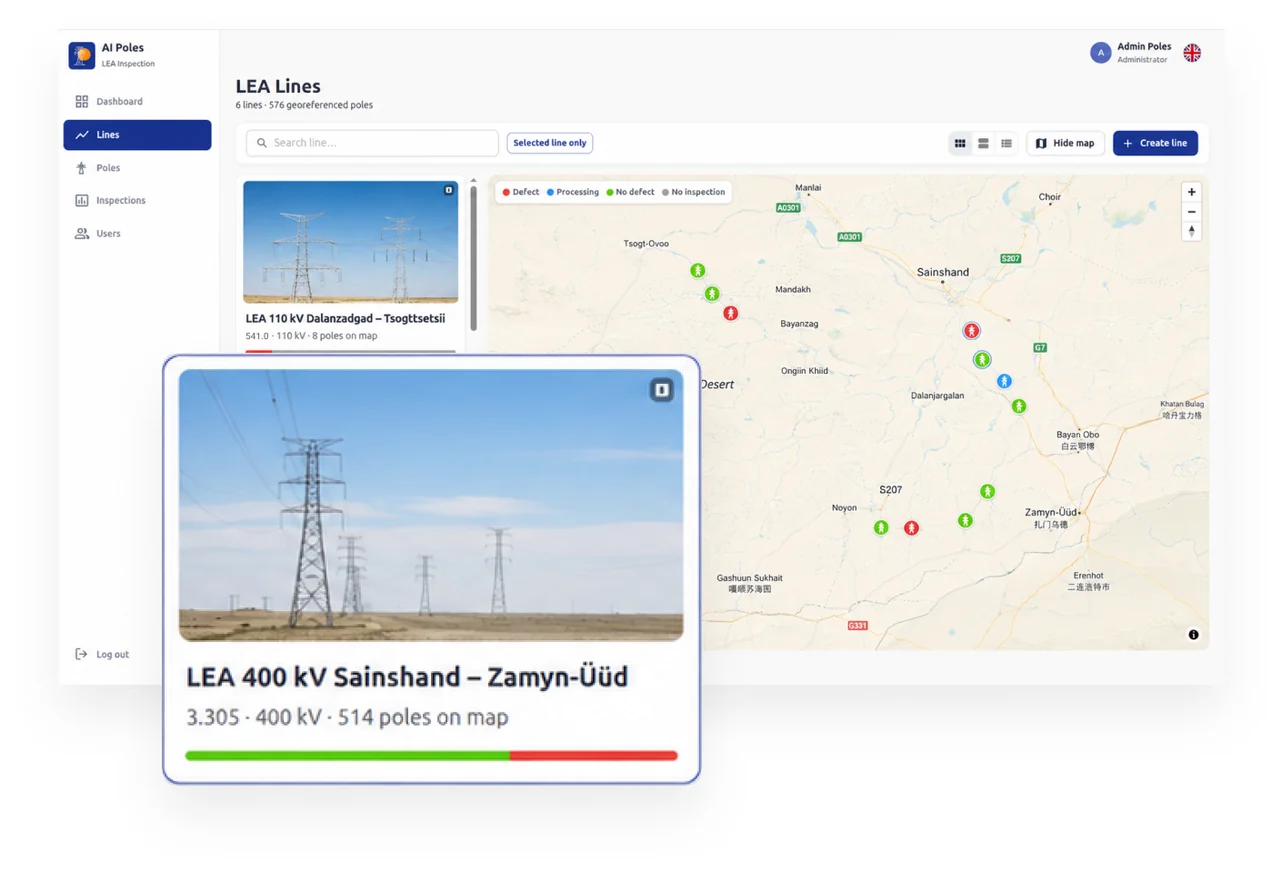
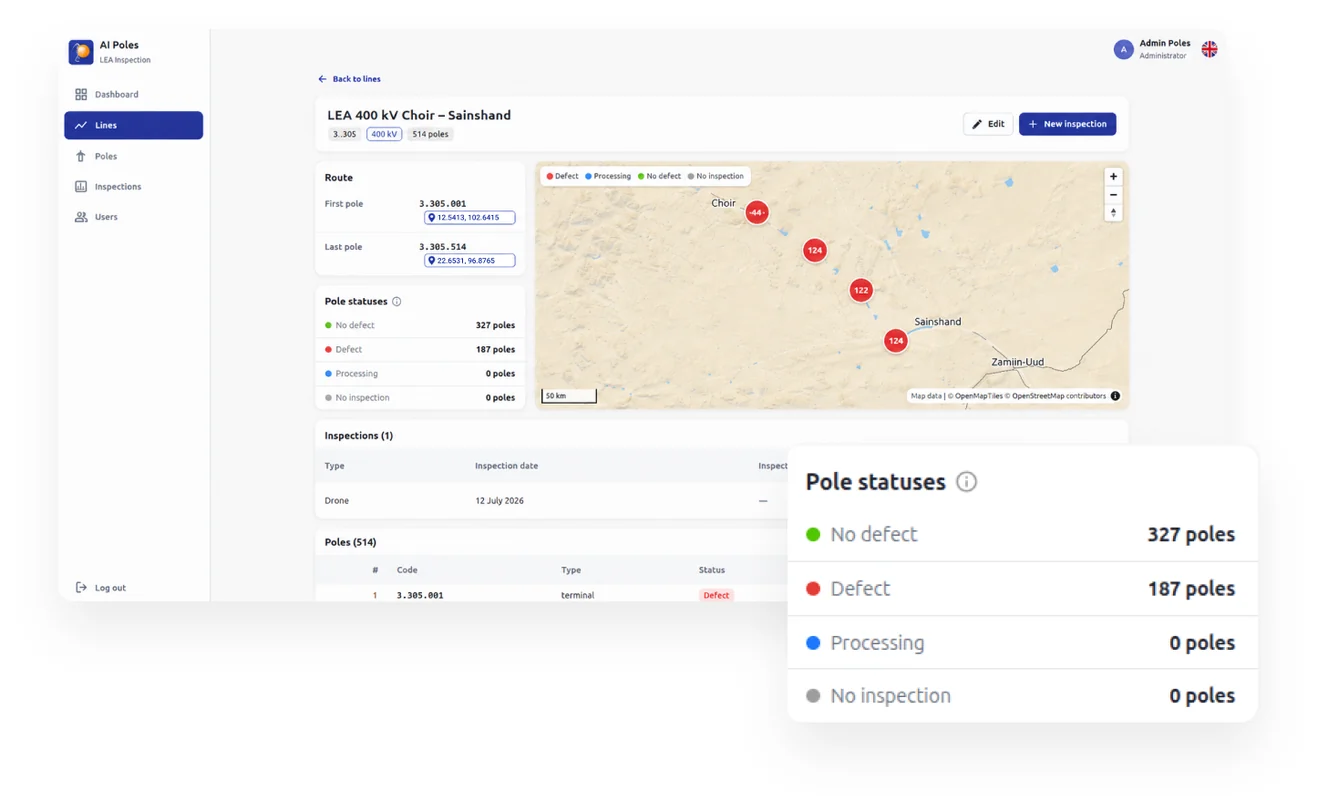
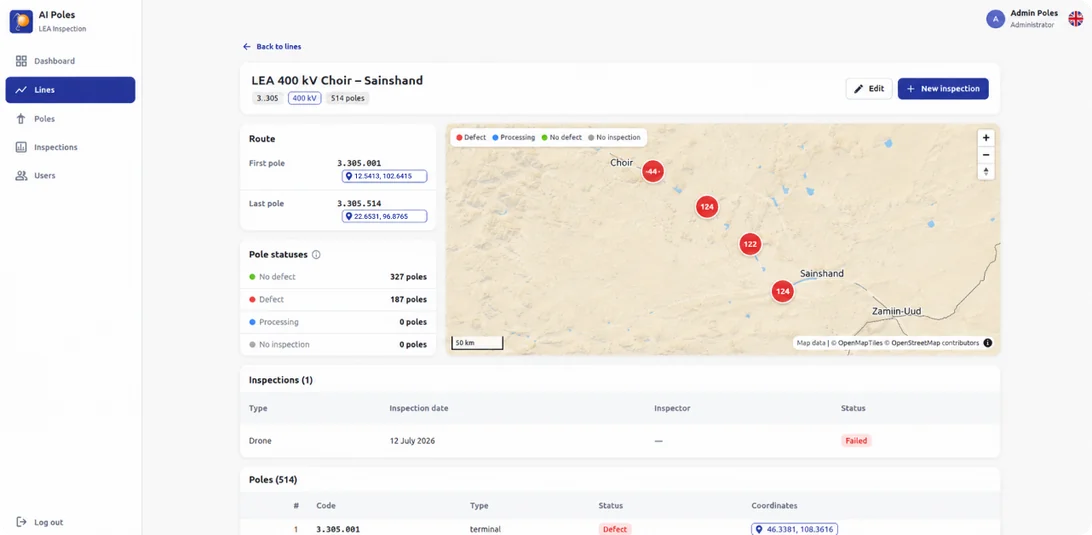
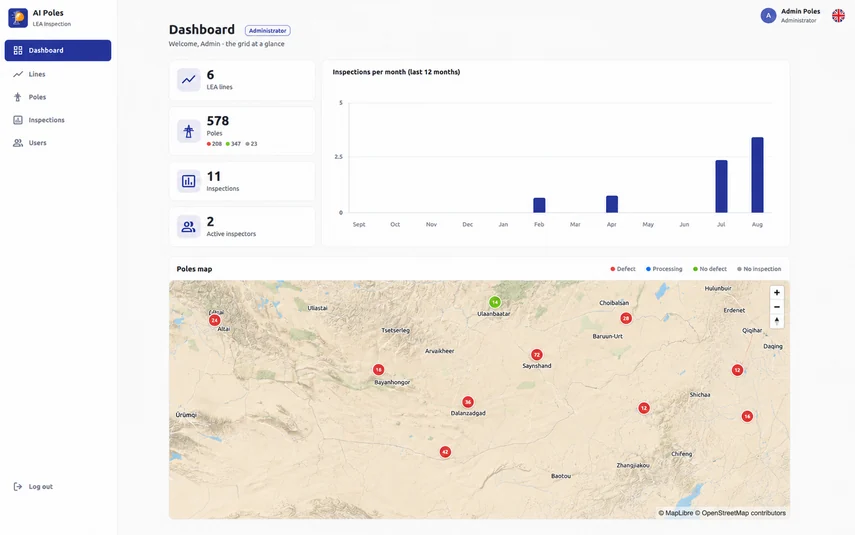
The workflow starts by registering a transmission line and its poles in the application. Pole coordinates can also be displayed on a map. When a new inspection takes place, drone photographs are uploaded to the platform. A predefined naming convention allows the system to associate each photograph with the correct pole automatically.
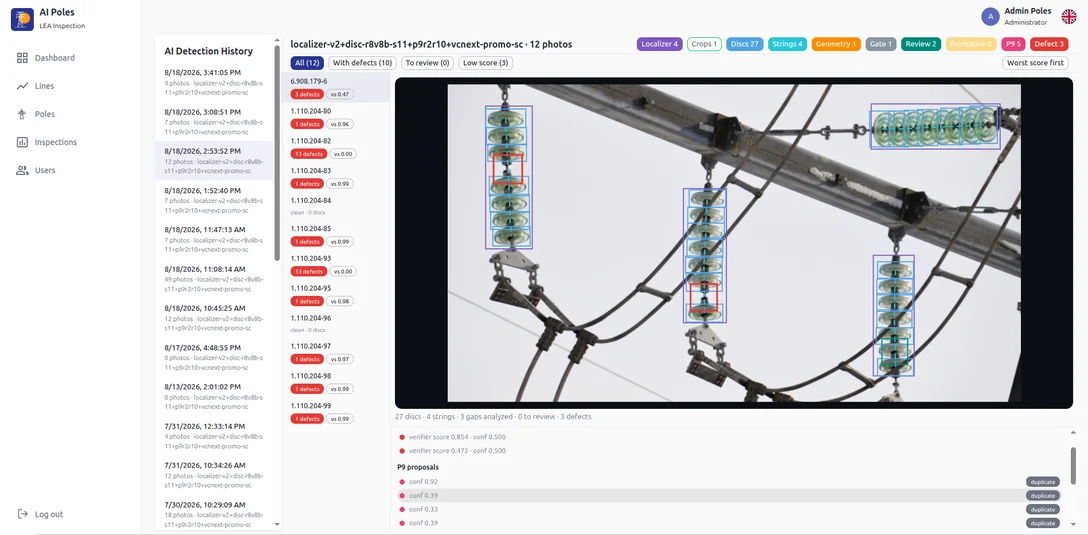
The Computer Vision pipeline then processes the images and searches for missing discs within the insulator strings. Potential defects are presented to the operator for validation. Once confirmed, the corresponding pole is identified as having a defect in the latest inspection and is visually highlighted on the map.
After maintenance work is completed, a new inspection can be created and new images uploaded. If the defect is no longer detected and the new inspection confirms the corrected condition, the pole returns to its normal status. This creates a continuous inspection history rather than a one-time defect report.

The AI Detection Pipeline
1. Insulator Localization - The first stage identifies the relevant insulator strings within the full-resolution drone image. This limits subsequent processing to the areas that matter.
2. Individual Disc Detection - A second model identifies the glass discs forming each insulator string. Their positions provide information about the normal spacing and structure of the component.
3. Geometric Analysis - The system analyzes the sequence of detected discs and searches for irregular spacing that may indicate a missing element.
4. Independent Defect Detection - A separate model searches directly for visual patterns associated with missing discs. Using an independent detection path helps identify candidates that may not be obvious from geometry alone.
5. Candidate Verification - Potential defects are analyzed again using their surrounding visual context. This stage is designed to eliminate a large proportion of false alarms before results reach the operator.
6. Human Confirmation - The remaining candidates are displayed in the application, where an inspector can confirm or reject them. These decisions also create valuable labeled data that can be used to improve future versions of the models.
Implementation Process
Transmission lines and individual poles are registered in the application, together with the information required to identify them during inspections.
Outcome: A structured digital representation of the inspected infrastructure.
Inspection photographs are uploaded in batches and associated with their corresponding poles using the established image naming convention.
Outcome: Large inspection datasets can be organized automatically rather than manually matched image by image.
The local Computer Vision pipeline processes the photographs and identifies potential missing-disc defects.
Outcome: Operators receive a filtered set of relevant candidates instead of having to search the entire image archive.
An operator reviews each candidate and confirms or rejects the AI finding.
Outcome: Maintenance decisions remain under human control while the system handles the repetitive screening work.
After repairs, another inspection can be added to the same line. New photographs are analyzed using the same process.
Outcome: The application can reflect the latest inspected condition of each pole and maintain an inspection history over time.
Performance Metrics
During project evaluation, the system demonstrated the ability to bring approximately 90 out of every 100 known defects to the inspector’s attention.
The processing pipeline is also designed for large inspection batches. A power line containing 1,525 high-resolution photographs can be processed in approximately 35–50 minutes, depending on the environment and images being analyzed.
These figures represent the results obtained during the project’s current evaluation phase and should be interpreted in the context of the available client dataset.
Key Technologies

Transformer-based object detection models are used for several visual tasks, including insulator localization, individual disc detection and direct defect detection.

A self-supervised vision backbone is used within the verification pipeline to distinguish genuine missing-disc patterns from healthy components that visually resemble defects.

A lightweight neural network architecture is used for one of the verification tasks where a smaller model provides the required performance without unnecessary computational overhead.

Used for model training and experimentation.

Models are exported to a portable inference format, allowing parts of the AI pipeline to run efficiently on CPU resources and reducing dependency on specific training environments.

Hosted locally for image annotation and dataset preparation. The annotation workflow uses the COCO format to exchange structured image labels between components.

Used for the inspection interface, image galleries, validation workflows and visualization of detection results.

Provides the application’s API layer and coordinates the inspection workflow.

The Computer Vision models run within a separate Python detection service exposed internally through a controlled API.

Stores inspection data, images metadata, detected defects, operator decisions and the information required to reconstruct the decision process.

The application and AI services are containerized so the complete solution can be deployed within the client’s infrastructure.
Technical Architecture
One of the defining requirements of the project was that inspection photographs remain inside the client’s environment. For this reason, the Computer Vision service runs on an internal network without an external internet route.
Images are stored locally, models run locally and the application’s processing workflow does not depend on cloud AI APIs.
The architecture separates the business application from the AI detection service. Inspection management, users, poles and workflow information are handled by the application layer, while computationally intensive image analysis is performed by the dedicated Python service.
Asynchronous processing allows an entire transmission line to be analyzed as a background job while the application remains available to users.
This architecture also makes individual AI models replaceable. As improved models become available, they can be evaluated and introduced without rebuilding the entire inspection platform.
Human-in-the-Loop Learning
Inspector feedback plays an important role in the project. Every confirmed or rejected candidate provides information about how the system performs on real inspection images. During the project, the dataset accumulated:
analyzed photographs across 577 poles
inspector-confirmed defects
rejected detection candidates
defects manually identified by inspectors after being missed by the system
Rejected candidates are particularly useful because they show exactly which visual situations confuse the models.
This creates a practical feedback loop: the system performs the initial screening, the expert corrects it where necessary, and those corrections can inform later training cycles.

Security & Data Privacy
For critical infrastructure projects, data handling is part of the architecture rather than an additional feature. The detection environment was therefore designed to operate offline.
Inspection photographs are processed locally and are not submitted to third-party Computer Vision or generative AI services. The same principle applies to annotation and model inference.
This approach gives the client control over sensitive infrastructure imagery while still allowing modern Computer Vision models to be used operationally.
Results & Benefits
- Less time spent searching manually through thousands of drone photographs.
- Potential defects are presented directly for review.
- Confirmed issues remain associated with the corresponding transmission pole.
- Inspection history provides context about the latest known condition of the infrastructure.
- Human expertise remains part of every final defect decision.
- Defects can be connected to their physical location and corresponding pole.
- Confirmed findings provide a clearer starting point for maintenance planning.
- Follow-up inspections can verify the condition after intervention.
- A repeatable digital workflow replaces fragmented image review and manual reporting.
- Large inspection datasets can be analyzed considerably faster.
- Sensitive infrastructure images remain within the organization’s own environment.
- Inspector feedback creates reusable training data.
- The architecture can be expanded without redesigning the entire application.
Future Roadmap & Planned Enhancements
Missing-disc detection represents the first stage of a broader Computer Vision approach to power infrastructure inspection. The same inspection workflow and technical architecture can be extended with additional specialized models.
The objective is to progressively increase the amount of an inspection that can be screened automatically while keeping expert validation at the center of maintenance decisions.
Planned areas of development include:
- Metal structure inspection - identifying visible problems affecting structural components.
- Rust and corrosion detection - highlighting areas showing signs of deterioration.
- Vegetation monitoring - detecting vegetation that may require trimming around transmission infrastructure.
- Multi-image analysis - comparing several views of the same component when a single photograph does not provide enough visual information for a reliable decision.
The Outcome
The project can change a simple but expensive part of infrastructure inspection: finding the few relevant problems hidden inside thousands of photographs.
Drone teams can continue collecting inspection images as before. The difference happens afterwards. Instead of asking an inspector to examine every image with the same level of attention, the Computer Vision system performs the first pass and brings potential problems forward. The inspector makes the decision.
For an organization managing large amounts of critical infrastructure, that distinction matters: AI handles the repetitive search, while responsibility for the final assessment remains with the people who understand the infrastructure.