Business Credit Limit
Extend Credit with Confidence
B2B relationships often involve payment terms, spending limits, and negotiated credit agreements. The Business Credit Limit module brings these capabilities directly into your e-commerce platform, allowing you to offer flexible purchasing terms while maintaining full control over financial exposure.
By defining how much each company can spend, businesses can streamline purchasing processes, strengthen customer relationships, and reduce financial risk.
Flexible Credit Management
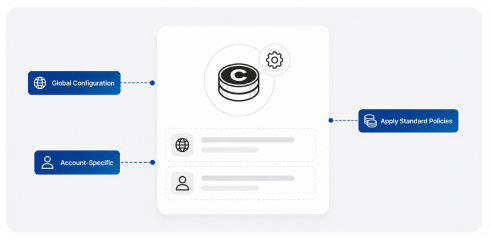
Credit limits can be configured globally for all customers or tailored individually for specific accounts.
This flexibility allows businesses to apply standard policies across their customer base while accommodating key clients with custom credit arrangements.
Key Benefits
- Global or per-company credit limits
- Support for personalised customer agreements
- Flexible configuration options
- Easy administration
Real-Time Credit Tracking
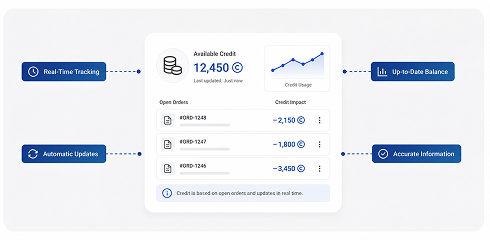
The platform continuously tracks credit usage based on open orders, providing an up-to-date view of each customer's available balance.
As orders are completed or canceled, available credit is automatically released, ensuring both your team and your customers always have accurate information.
Key Benefits
- Real-time credit calculations
- Integrated with your ERP for complete data
- Automatic balance updates
- Greater financial visibility
Complete Visibility for Your Team
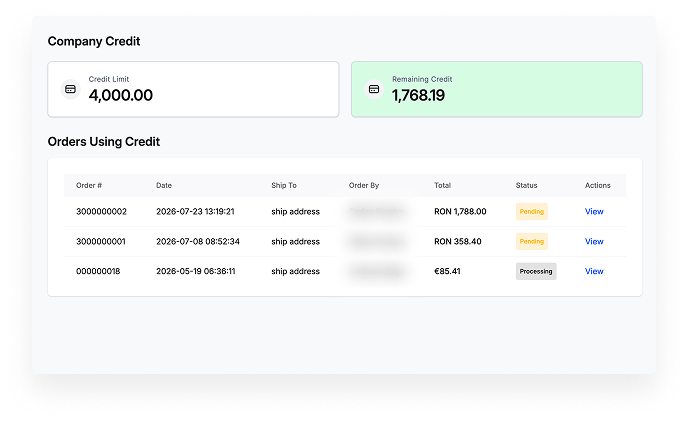
Sales teams and account managers have immediate access to important credit information, including current limits, used credit, remaining balance, and the orders contributing to outstanding exposure.
Credit information is available directly within company accounts and administration grids, making it easy to monitor customer portfolios and identify accounts approaching their limits.
Automated Credit Enforcement
When a customer reaches their credit limit, the platform automatically blocks new orders until some of the outstanding payments are processed. This helps businesses protect themselves from excessive exposure while ensuring purchasing policies are enforced consistently across all accounts.

Global
and per-company credit limits

Automatic credit calculations

Credit visibility for internal teams

Real-time credit tracking

Order blocking when limits are reached

Customer-facing credit dashboards

Support
for custom payment agreements
Company Invoice Billing
Simplify Company Invoicing for Individual Buyers
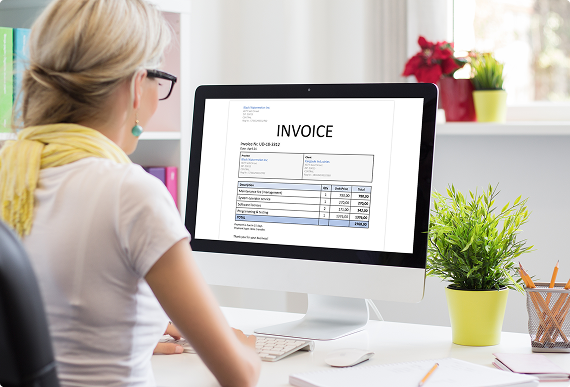
Not every business purchase comes from a registered B2B account. Freelancers, sole traders, and employees purchasing on behalf of their company often need business invoices without going through a full B2B onboarding process.
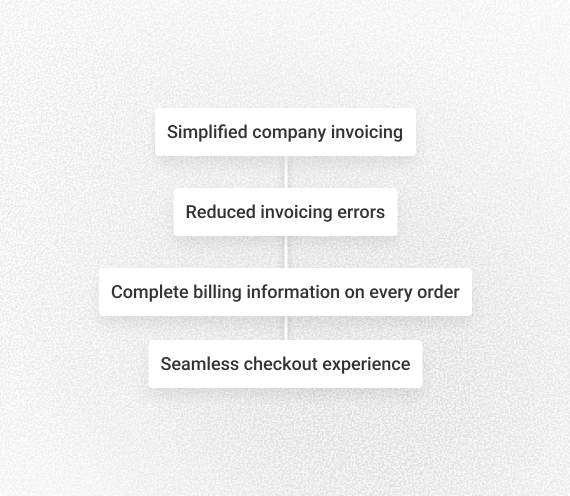
Company Invoice Billing allows customers to provide company details during checkout, ensuring orders contain all the information required for accurate invoicing while keeping the purchasing process simple and efficient.
Company Billing at Checkout
Customers can choose to invoice an order to a company directly during checkout. When selected, additional fields appear, allowing them to provide business details such as company name, tax information, registration number, and banking details.
The platform validates the information before the order is placed, ensuring finance teams receive complete and accurate billing data.
Save Company Details for Future Orders
Once entered, company information is stored within the customer's profile and automatically reused during future purchases.
This eliminates repetitive data entry, speeds up checkout, and helps maintain consistency across invoices.
Key Benefits
- Faster repeat purchases
- Improved data consistency
- Reduced administrative effort
- Better customer experience
Complete Order Information
Company billing details travel with the order throughout the fulfillment process and remain available to finance teams, ERP systems, and order administrators.
This ensures invoices are generated correctly and all business information is readily accessible when needed.
Key Benefits
- Accurate invoicing
- Better integration with ERP and accounting systems
- Improved order management
- Greater operational efficiency
Works Alongside B2B Accounts
Company Invoice Billing is designed for customers who need occasional or regular company invoices without requiring a dedicated B2B company account.
It complements the full B2B account structure, allowing both purchasing models to coexist seamlessly on the same platform.
Support for both B2B and B2C scenarios
Flexible purchasing options
Self-service company invoicing
Simplified customer journeys
Flexible Configuration
Businesses can decide which billing fields are required and configure the checkout experience according to local requirements and invoicing policies.
Fields can be enabled or disabled individually, while labels and translations can be adapted to support multiple markets and languages.
Key Capabilities
- Company invoicing directly from checkout
- Automatic validation of billing information
- Saved company details for repeat purchases
- Complete business information attached to orders
- Support for mixed B2B and B2C scenarios
- Configurable fields and localization support
Company Sales Targets
Turn Purchasing Goals into Repeat Revenue
Growing B2B revenue is often less about acquiring new customers and more about encouraging existing ones to buy more, more often. Yet many businesses still manage sales targets and rebate programs manually, relying on spreadsheets and account managers to track progress.
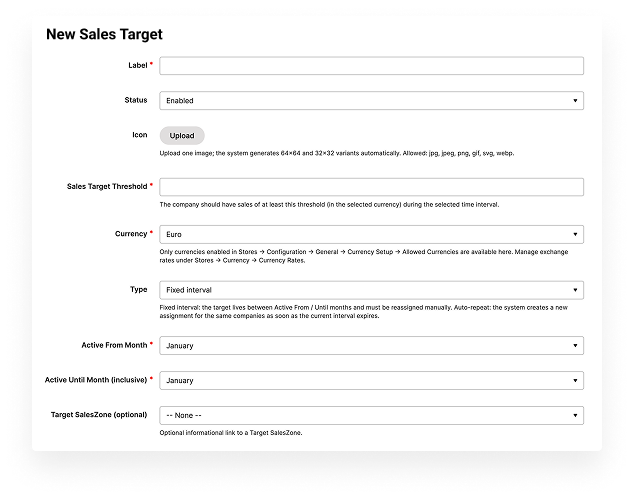
Company Sales Targets brings goal-based purchasing directly into your B2B platform. You can assign spending targets to individual companies, monitor progress automatically, and encourage repeat orders through visible milestones and incentives.
Create Company-Specific Targets
Every B2B customer can have its own purchasing objective, tailored to its size, market, or commercial agreement.
Targets can be created for: Individual customers, Preferred partners, Specific geographical regions, Seasonal campaigns, Loyalty and rebate programs, Monthly / Quarterly / Annual volume agreements.
Each target includes its own amount, currency, geographical region, label, and timeframe.
Key Benefits
- Personalized commercial agreements
- Better customer segmentation
- Support for loyalty and rebate programs
- More predictable revenue

Individual customers

Preferred partners

Seasonal campaigns

Loyalty and rebate programs

Monthly / Quarterly / Annual volume agreements

Automatic Progress Tracking
Once a target is assigned, every order contributes to the company's progress automatically. There is no need for spreadsheets or manual calculations.
Businesses can choose how progress is measured:
- Completed orders
- Non-cancelled orders
- Paid invoices
Orders in different currencies are converted automatically, ensuring accurate reporting across markets.
Key Benefits
- Real-time visibility
- Elimination of manual work
- Accurate performance tracking
- Multi-currency support
Fixed Campaigns or Recurring Goals
Targets can run once or renew automatically every 1, 3, 6, or 12 months.
Recurring targets allow businesses to maintain long-term purchasing programs without administrative effort. At the end of each cycle, the system records the outcome and starts the next period automatically.
Key Benefits
- Seasonal promotions
- Annual commitment programs
- Automated renewals
- Reduced operational overhead
Customer Visibility Drives Engagement
Customers can see their current progress directly from their account dashboard. A dedicated progress card shows how close they are to reaching their target, creating a strong incentive to place additional orders.
This transforms a back-office metric into a customer-facing growth tool.
Key Benefits
- Increased order frequency
- Higher average order values
- Improved customer engagement
- Greater loyalty
Complete History and Flexible Management
Each target records its outcome and maintains a history of achieved, missed, or cancelled goals. Administrators can:

Adjust recognized revenue

Mark targets as fulfilled manually

Skip automatic renewals when needed

Apply targets to specific regions or territories

Configure branded tiers and reward programs
Built for B2B Commerce
Unlike external loyalty tools or spreadsheet-based processes, Company Sales Targets works directly with the existing B2B company structure and order data.
It integrates naturally with company accounts and runs in the background, allowing sales teams to focus on relationships instead of administration.
This feature is particularly valuable for wholesalers, distributors, manufacturers, franchise networks, and businesses that rely on repeat purchasing and long-term customer relationships.
Key Capabilities
- Company-specific purchasing targets
- Fixed or recurring sales cycles
- Automatic target renewal
- Real-time progress tracking
- Multiple measurement methods
- Multi-currency support
- Customer dashboard progress cards
- Historical target results
- Regional sales zones
- Manager overrides
- Branded loyalty tiers
- Flexible configuration and automation